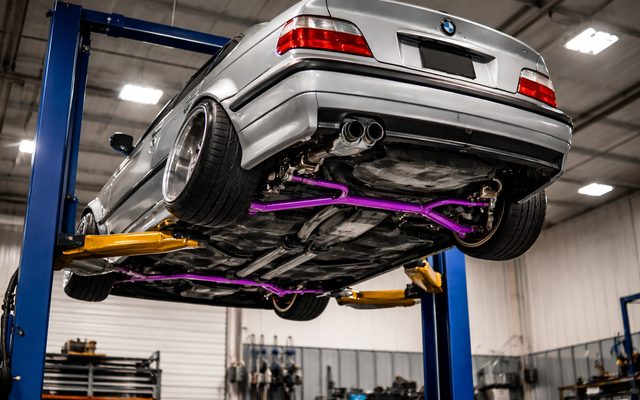
Within the demanding world of modern professional sliding, success is no longer purely a function of brute torque or pilot bravado. Instead, it has evolved into a multifaceted engineering challenge that requires a painstaking marriage of choosing a proven chassis, outfitting it with the correct performance hardware, and, most critically, grasping its dynamic performance on the circuit through cutting-edge drift telemetry software. This exhaustive handbook acts as your blueprint starting from the very first concept of a project car right through to the last telemetry-optimized refinements that elevate a strong machine into a repeatable champion. We will examine in detail the art and science of chassis dynamics adjustment, showing how a modern vehicle dynamics tool like a dedicated telemetry system eradicates guesswork and delivers exceptional insight into your car's actual dynamics.
The bedrock of any successful drift car is, without question, the platform itself. A select group of vehicles have attained legendary reputation within the worldwide drifting scene due to their natural handling characteristics, robust design, and the vast ecosystem of performance components available. Selecting the correct starting point is the primary and most important selection a builder will make. For instance, the BMW E36 is universally acknowledged as among the finest all-around drift cars of the modern era. Its near-perfect evenly distributed mass, coupled with a rear-wheel-drive configuration and extremely reliable straight-six engines, creates a chassis that is at once accessible for beginners and highly effective in the possession of a pro driver. The next step of this philosophy, the E46 model BMW, improves on these qualities with a increasingly refined frame, wider stance for improved confidence, and even more lock as standard from the factory. A distinct dominant option in the top-level scene is the C6 generation Corvette.
This muscle-derived sports car offers a unique set of benefits to the drifting sport, including a low-mass aluminum chassis, a transaxle-style transaxle that helps create an ideal front-to-rear mass ratio, and the colossal torque of a powerful GM LS engine. This combination makes it an absolute force on track, able of starting and sustaining extended angles with apparently effortless application of acceleration. For builders looking for exceptional bang-for-the-buck, the 350Z model Nissan rises above as a prime choice. It is delivered from the manufacturer with a stiff body structure, a competent OEM LSD, and the smooth V6 engine that delivers sufficient power and torque for learning and moving up in the sport. Its follow-up, the Nissan 370Z, presents additional refinements in chassis stiffness, steering geometry, and peak engine power, cementing its place as a favorite selection among competitive competitors. Other iconic cars that warrant mention encompass the agile rotary-powered Mazda FC RX-7, the ever-present Nissan S13 240SX, the V8-powered Ford SN95, the modern BMW E90, and the tiny yet surprisingly engaging and teachable MX-5 Miata. Each of these platforms offers a distinct set of attributes, complexities, and possibilities, but they all have in common the fundamental components required to serve as a competitive drift machine.
However, picking the optimal car is just the beginning. To access the true performance of every of these vehicles, significant changes to the steering system and chassis control systems are completely non-negotiable. This is where the world of specialist aftermarket parts comes into sharp view. The one most game-changing modification for a purpose-built competition vehicle is the fitting of a high-performance angle modification kit. These advanced assemblies, such as those engineered by industry leaders like SLR Speed, are created to dramatically increase the chassis's possible steering angle. A factory street car is extremely limited in how far its steering tires can pivot, a engineering trade-off for public road operation. In drifting, however, aggressive opposite lock is frequently required to manage and hold a drift. An angle kit substitutes the stock uprights, rod ends, and potentially control arms with parts that enable the front tires to attain angles in excess of 70 or even 80 degs, compared to a typical OEM angle of around 40 to 50 degs.
This immensely expanded steering angle offers the driver with exponentially more control during a angle, enabling it to be much simpler to initiate a slide, hold it through a extended turn, and transition fluidly from one side to the other. The difference in handling is truly transformative. Paired with a appropriately specified steering kit is the equally vital modification to the vehicle's spring and damper setup. Generic or including premium road coilovers are simply not intended for the specific and brutal demands of competitive oversteer. A drift-spec system of suspension units is paramount. These engineered suspension components feature unique valving and spring rates that are designed for the violent mass transition that is inherent of drifting. When a driver initiates a slide, the chassis's weight is thrown violently to the front of the bend. Proper performance coilovers manage this movement in a controllable fashion, permitting the car to stabilize promptly and providing the operator clear feedback through the controls and driver's seat. They furthermore enable precise adjustment of ground clearance, rebound and compression stiffness, and weight balance, which are all integral aspects of dialing in the car's behavior to a specific circuit or piloting style. In combination, a precision-engineered angle modification system and a properly chosen system of performance coilovers constitute the core mechanical cornerstone upon which all future optimization is based.
Once the essential parts is installed, the subsequent vital stage in the project is the precise setting of the vehicle's alignment. This is the domain of car suspension tuning, a methodology that can appear intimidating to the newcomer but is, in fact, the defining factor to turning a collection of fast parts into a cohesive and predictable vehicle. The most debated element of suspension geometry for drifting is certainly negative camber. Camber is the tilt of the wheel relative to the vertical plane when observed from the front-on of the car. When the upper part of the wheel is leaning towards the car, this is known as camber-in. For sliding, an inward tilt on the front axle tires is widely applied and is seen as critical. The purpose is intrinsically tied to vehicle dynamics.
When a car is turning at extreme angles, the body tilts to the external of the corner. This chassis roll causes the outside front wheel to diminish its best footprint with the track surface. By introducing negative camber, the wheel is pre-leaned to counteract this roll. As the car tilts into the bend, the tire becomes more upright against the asphalt, optimizing its traction at the precise point when it is absolutely essential for steering authority. Typically, front adjustments for a serious drift car fall between approximately -3 degrees to as high as -5 degrees or even greater, depending on the parameters of the car setup, compound selection, and driver feel. The rear axle wheels also employ inward tilt, but the values are typically less and less aggressive than the front. Excessive negative camber at the back can cause the vehicle to overly prone to oversteer and difficult to predict on throttle application, as it diminishes the effective grip area of the driving tires during straight-line throttle application. Thus, rear axle angles are commonly in the ballpark of -1 degree to -3 degrees, achieving a careful equilibrium between offering adequate side traction to help in entering and holding the angle while still maintaining effective grip for power-down the bend. Camber is only one element of the broader tuning picture, which additionally includes suspension tuning tool toe angle, self-centering steering, and bump steer adjustment.
Toe refers to the orientation of the tires when viewed from a bird's-eye view. Toe-in means the front edges of the tires are nearer together than the rear edges, while outward toe means the converse. For drifting, a slight amount of front axle negative toe is often employed to improve the initial steering reaction, making the chassis feel more nimble and ready to begin a slide. Rear toe setting is generally set to zero or a very small amount of inward toe to foster stability under acceleration. caster angle is the longitudinal or aft inclination of the steering axis when looked at from the side-on of the car. More caster angle increases steering feel and high-velocity confidence, and it additionally boosts camber effect during steering, which is highly beneficial. Adjusting these parameters is a complex dance where a modification to a single value can and often will influence the others. The traditional method for dialing in a car's alignment for drifting has long been a tedious process of trial and error. A driver or team would make a modification based on a hunch, run the chassis on track, depend on the pilot's personal sensation and comments, and then make another adjustment. This cycle would iterate time after time until the chassis felt "right" or the allotted testing session was exhausted. This methodology is not only exceptionally wasteful in terms of hours and tires, fuel, and parts, but it is also fundamentally flawed.
Pilot perception is a infamously unreliable measurement tool, affected by numerous factors such as fatigue, evolving track surfaces, ambient heat, and simply the focus of the pilot on that specific day. What feels "tail-happy" on one run might feel "tight" on the subsequent run, leading to confusing data and ineffective adjustments. This traditional problem in car suspension tuning is precisely where state-of-the-art engineering tools has stepped in to transform the methodology.
The advent and application of sophisticated drift telemetry software has introduced a completely new paradigm for engineering and optimizing high-performance drift cars. This new generation of systems, showcased by groundbreaking systems like modern telemetry hardware, function by physically measuring the live physical movement of the chassis as it is operated on the course. In contrast to using personal feedback, these tools acquire objective information on key parameters such as damper compression and extension, individual tire rotation, acceleration forces, wheel angle, and driver input application. This acquired data stream is then analyzed by sophisticated software that can graph suspension engineering and decode the information in a comprehensible format. For the first time, engineers and builders can see precisely what the chassis is exhibiting at every moment of a lap. This capability transforms the whole chassis setup process. Think about the particular goal of dialing in the front camber for a specific vehicle. Instead of making a adjustment from -3 degrees to -3.5 degrees and then driving many passes to try and "feel" a difference, a vehicle dynamics tool can give real-time and definitive feedback. The software can display visually how the wheel's loading is acting during the key phases of a drift: initiation, mid-corner, and switch. It can show if the existing angle is enabling the loaded tire to achieve ideal loading or if the compound is working inefficiently on its external shoulder.
The software can after analysis suggest fact-based advice for modification. Perhaps the information reveals that the outside front tire is even overloading its outer shoulder at -3.5 degrees of negative camber, implying that a move towards angle, say -4 degrees, might be warranted. Alternatively, the information might indicate that the tire is not coming up to temperature or that the inside edge is degrading too quickly, which could indicate that there is too much negative camber and a modest lessening back to -3.2 degrees would be more ideal. This degree of precision and actionable analysis was completely unattainable in the days of pure seat-of-the-pants adjustment.
The effect of using a comprehensive vehicle dynamics tool reaches well beyond just optimizing alignment. It serves as an invaluable suspension tuning guide that is customized to your particular car. When setting the rebound and compression values on your coilovers, instead of using imprecise advice or replicating another team's setup, you can employ the data to see how the vehicle is reacting in response to your tweaks. The tool can show the wheel movement path over a section of track, revealing if the coilovers are handling the body movement properly or if they are allowing the vehicle to oscillate uncontrollably after a direction change. It can aid in diagnosing issues like bottoming out or losing droop, enabling you to apply informed decisions to helper springs, damping values, or ride height. This process translates equally to the intricate art of suspension geometry optimization. Beyond camber angle, the system can provide analysis into how modifications to toe and caster angle are affecting the chassis's stability during various phases of a drift. For example, it can assist you to determine the optimal amount of front axle negative toe for your specific steering rack setup and piloting technique by measuring the quickness of turn-in reaction and the stability of the vehicle at full lock. This transforms the tool an exceptionally powerful vehicle dynamics manual that is constantly updated by the real-world behavior of your specific chassis on the track. It shifts the complete endeavor from a mysterious craft into a scientific optimization procedure.
Additionally, the value of a tool like GripDial is not confined to expert engineers with large resources. For the club-level enthusiast, it serves as an powerful equalizer. It practically gives the driver with the knowledge of a expert race engineer without the associated cost. It speeds up the development time by giving clear directions to challenges that would otherwise take years of experimentation to answer. A tuner can see how their specific vehicle reacts to different inputs, building a more profound understanding of car control in the journey. It also opens up professional performance tuning principles, allowing anyone with the drive to perfect their machine to do so in a systematic and effective manner. This is particularly valuable in a discipline like drifting, where setup know-how has traditionally been a closely guarded asset among top drivers. Today, that knowledge can be in the toolkit of any dedicated builder.
In the final analysis, the path to building and optimizing the perfect competitive sliding vehicle is a multi-faceted project that perfectly blends classic mechanical knowledge with 21st-century data tools. It starts with the informed choice of a proven chassis, then built upon the integration of non-negotiable drift-spec components like drift-spec angle modification systems and correctly specified performance coilovers. The process then moves into the detailed stage of car suspension tuning, where values like camber, toe setting, and caster are precisely set to complement the car's upgraded geometry and the operator's individual needs. Finally, and what really separates the contemporary process from the old ways, is the use of a sophisticated suspension tuning application. This tool eradicates the guesswork and waste of only subjective adjustment by providing quantifiable, actual data on how the car is really performing. It serves as an indispensable suspension tuning tool, a definitive drift suspension tuning guide, and a comprehensive chassis development system. Together, this integrated philosophy leads to that every element of the competition suspension engineering vehicle—from the pick of the chassis to the last adjustment on the suspension—is optimized for maximum competitiveness on the competition venue. It embodies the full evolution of the discipline of sliding, connecting mechanical driving skill with precise chassis dynamics to build the perfect dominant vehicles possible.